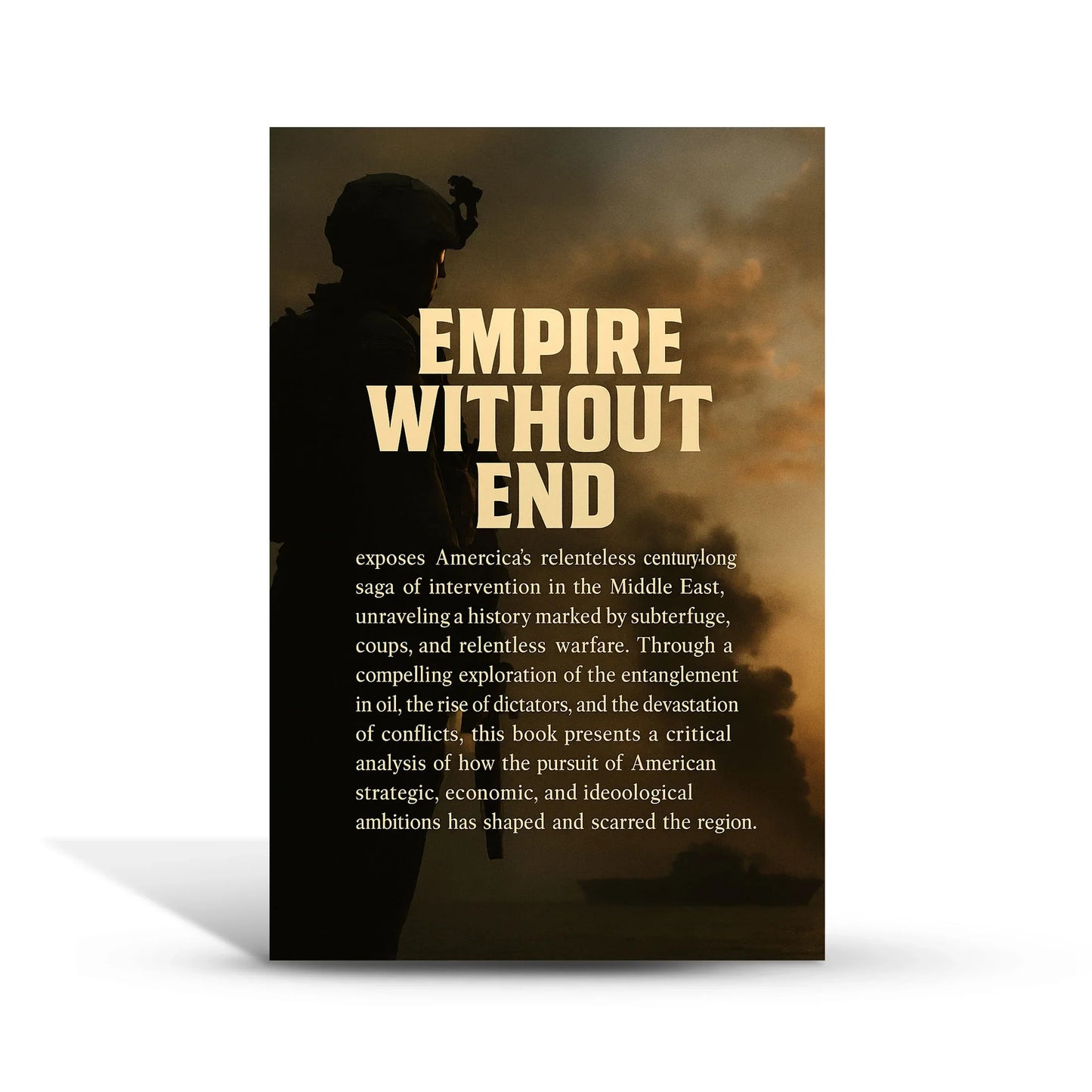
Empire Without End: America’s Hundred-Year War in the Middle East is a sweeping, unflinching examination of how the United States became the central architect of modern Middle Eastern conflict—and how that role evolved into a permanent condition of intervention, coercion, and control. Spanning more than a century, this book traces the transformation of American power from cautious postwar influence into an empire sustained by war, oil, finance, and narrative dominance. It is not merely a history of foreign policy, but a moral and structural autopsy of how ideals were converted into instruments of domination.
The story begins at the moment when old European empires began to fade. As Britain and France withdrew from the Middle East after the Second World War, they left behind artificial borders, fragile states, and unresolved grievances. Into this vacuum stepped the United States—initially as a self-proclaimed stabilizer, later as an enforcer. The book meticulously reconstructs how Washington inherited the imperial mantle, not through formal colonization, but through covert operations, economic leverage, military alliances, and ideological conditioning. What emerged was an empire without governors or flags, but with bases, contracts, and dependencies.
Read the sample
At the heart of this narrative lies the 1953 CIA coup in Iran, the overthrow of Prime Minister Mohammad Mossadegh, and the restoration of a pliant monarchy. This event is treated not as an isolated scandal, but as the blueprint for everything that followed. Through it, the book shows how sovereignty became intolerable when it threatened corporate and strategic interests, and how democracy was quietly sacrificed at the altar of oil. From that moment forward, the Middle East became a proving ground for a new kind of power—one that thrived in shadows and spoke the language of freedom while practicing the mechanics of control.
As the decades unfold, Empire Without End moves through the rise of authoritarian allies, the cultivation of strongmen, and the normalization of repression as long as it served American objectives. The Shah of Iran, the Saudi monarchy, Egyptian generals, Iraqi dictators, and Gulf princes are all examined not simply as regional actors, but as components of a broader system. The book reveals how military aid, intelligence cooperation, and diplomatic protection created regimes that survived not on legitimacy, but on external sponsorship. Stability became a euphemism for obedience.
The Cold War chapters expose how the Middle East was transformed into a chessboard of proxy conflicts, where local populations paid the price for global rivalries. Yet the book makes clear that the end of the Cold War did not bring peace. Instead, it removed restraint. With no rival superpower to check its ambitions, the United States entered what it perceived as a unipolar moment—an era in which intervention became policy rather than exception. Wars no longer needed victory; they needed continuity.
Nowhere is this more evident than in the Iran–Iraq War, which the book presents as one of the most cynical episodes of modern history. Fueled by Western intelligence, weapons, and silence, the conflict destroyed two societies while enriching arms manufacturers and preserving a balance of weakness. The million dead are not treated as abstract numbers, but as evidence of how proxy war became a business model. This pattern reappears repeatedly: conflict engineered, managed, and prolonged to prevent any regional power from achieving independence or coherence.
The Gulf War of 1991 marks another turning point. Marketed as a limited mission to liberate Kuwait, it introduced a new aesthetic of warfare—precision bombing, live television coverage, and moral spectacle. Yet the book goes further, detailing how the destruction of Iraq’s civilian infrastructure and the sanctions that followed amounted to a slow-motion catastrophe. Hospitals, water systems, and food supplies collapsed, while policymakers defended mass suffering as a necessary tool. The book exposes how economic warfare replaced colonial siege, and how punishment of populations became normalized.
The attacks of September 11, 2001, are treated with gravity, but also with clarity. Rather than serving as the origin of endless war, they are shown as the catalyst that allowed existing ambitions to accelerate. Afghanistan and Iraq become case studies in how fear was weaponized, intelligence manipulated, and public consent manufactured. The invasion of Iraq in 2003 is dissected in detail—not only as a strategic failure, but as a moral collapse that shattered international law, destabilized an entire region, and unleashed forces that could not be controlled.
From the ruins of Iraq emerged new forms of violence, new militias, and eventually the rise of ISIS. Empire Without End traces these developments not as inexplicable eruptions of extremism, but as direct consequences of state destruction and social disintegration. The book challenges simplistic narratives, showing how chaos is not the absence of order, but often the result of imposed order that ignores reality.
As the narrative advances into the 2010s, the book widens its lens to include Libya, Syria, Yemen, and Gaza—each a different expression of the same logic. NATO’s intervention in Libya, sold as humanitarian rescue, left a shattered state and open slave markets. Syria’s uprising, initially rooted in legitimate grievances, was transformed into a proxy war involving global powers, militias, and mercenaries. Yemen became a silent catastrophe, where starvation and disease were the weapons of choice. Gaza emerged as a laboratory of control, surveillance, and siege, revealing how modern warfare increasingly targets entire societies rather than armies.
One of the book’s most distinctive contributions is its exploration of how empire adapted to the digital age. As occupations became politically costly, control migrated into data, finance, and narrative. Social media platforms, surveillance technologies, cyberwarfare, and algorithmic propaganda are examined as the new instruments of dominance. The battlefield expanded from deserts and cities into minds and screens. Information became a weapon, truth a liability, and memory something to be managed.
The economic foundations of empire are laid bare through an analysis of the petrodollar system, global finance, and the role of oil in sustaining American power. The book explains how dollar dominance allowed the United States to finance wars without immediate consequence, and how that system is now under strain as the world moves toward multipolarity. The decline of unquestioned economic supremacy is presented not as speculation, but as a structural shift already underway.
Yet Empire Without End is not written solely from the perspective of power. Running through every chapter is the presence of those who endured it: civilians, dissidents, journalists, refugees, and ordinary people whose lives were shaped by decisions made in distant capitals. Their suffering is not romanticized, nor is their resistance ignored. The book insists on their centrality, arguing that history is not only made by empires, but by those who survive them.
In its final sections, the book turns inward, asking what this century of intervention has done to America itself. It examines the erosion of democratic norms, the militarization of culture, the hollowing of moral authority, and the normalization of permanent war. The empire’s greatest crisis, the book argues, is not external opposition, but internal exhaustion—a loss of purpose masked by nostalgia and denial.
Ultimately, Empire Without End is both a history and a warning. It challenges readers to confront uncomfortable truths about power, responsibility, and consequence. It rejects easy villains and simple solutions, insisting instead on structural understanding. This is a book for readers who want to understand not just what happened in the Middle East, but why it keeps happening—and what it reveals about the nature of modern empire.
Epic in scope, rigorous in research, and unapologetically direct, Empire Without End stands as a definitive account of a hundred years of intervention and its aftermath. It asks a final, unsettling question: when war becomes permanent, and empire becomes habit, can a superpower still choose another path—or has it forgotten how to stop?
Read the sample